
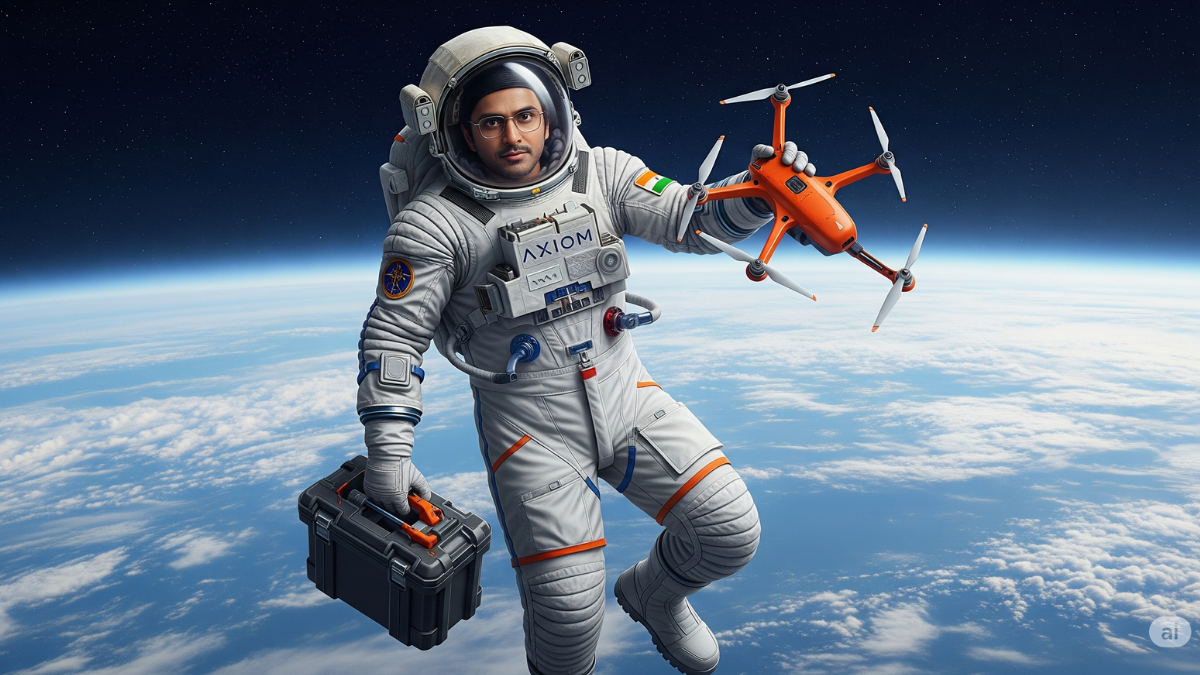
Axiom Space Astronaut: Shubhanshu Shukla:- On June 26, 2025, Axiom Space Astronaut: Shubhanshu Shukla made history as the first Indian to set foot on the International Space Station (ISS), marking a monumental milestone for India’s space ambitions. As part of the Axiom-4 mission, Group Captain Shubhanshu Shukla, a 39-year-old Indian Air Force pilot, embarked on a 14-day scientific expedition in low Earth orbit, carrying the hopes of 1.4 billion Indians. This journey, 41 years after Rakesh Sharma’s 1984 spaceflight, signals India’s growing presence in global space exploration.
Are you curious about what it takes to become an astronaut or how Shubhanshu Shukla is advancing India’s space program? This article dives into his inspiring journey, the Axiom-4 mission, his groundbreaking experiments, and what his achievement means for India’s future in space. From his early days in Lucknow to his role as mission pilot, we’ll explore every facet of this historic moment. Let’s blast off into the story of Axiom Space Astronaut: Shubhanshu Shukla!
Who is Shubhanshu Shukla?
Axiom Space Astronaut: Shubhanshu Shukla is a Group Captain in the Indian Air Force (IAF) and a test pilot with over 2,000 hours of flying experience. Born in Lucknow, Uttar Pradesh, Shukla’s journey to the stars began with his childhood dream of serving the nation, inspired by the 1999 Kargil War. He joined the National Defence Academy (NDA) and later became a decorated IAF officer before being selected by the Indian Space Research Organisation (ISRO) for the Axiom-4 mission.
Early Life and Education
- Hometown: Lucknow, Uttar Pradesh, India.
- Education: Graduated from the National Defence Academy; trained as a test pilot.
- Military Career: Served as a fighter pilot, accumulating extensive experience on frontline IAF platforms.
- Astronaut Training: Underwent rigorous training at Russia’s Gagarin Cosmonaut Training Center, followed by specialized preparation by ISRO and NASA.
Shukla’s disciplined upbringing and passion for aviation set the stage for his historic role. His selection as the mission pilot for Axiom-4 reflects his technical expertise and leadership skills.
Personal Life: A Love Story in Orbit
Shukla’s personal life is as inspiring as his professional journey. He married his childhood sweetheart, Kamna Mishra, in a heartwarming love story that has captured public attention. Their bond, rooted in shared values and mutual support, showcases the human side of this astronaut. His parents, Shambhu Dayal Shukla and Asha Shukla, expressed tearful pride at his achievement, with his mother stating, “These are tears of joy” during a public event in Lucknow.
The Axiom-4 Mission: A Global Collaboration
The Axiom-4 mission, launched on June 25, 2025, from NASA’s Kennedy Space Center in Florida, is a commercial spaceflight operated by Axiom Space in partnership with SpaceX and NASA. Shukla, serving as the mission pilot, joined three other astronauts: Commander Peggy Whitson (USA), Slawosz Uznanski-Wisniewski (Poland), and Tibor Kapu (Hungary). The mission docked with the ISS on June 26, 2025, at 4:05 pm IST, after a 28-hour journey aboard SpaceX’s Dragon spacecraft.
Mission Objectives
The Axiom-4 mission is Axiom Space’s most research-focused endeavor, with over 60 scientific experiments planned during the 14-day stay on the ISS. Shukla’s contributions include:
- Scientific Research: Conducting experiments on muscle degradation, bio-manufacturing, and bio-astronautics.
- Indian Experiments: Leading seven ISRO-proposed experiments, including studying water bears (tardigrades) in microgravity to understand biological adaptation.
- Operational Support: Assisting with cargo transfers, life support system inspections, and daily ISS operations.
Crew Dynamics
The Axiom-4 crew, dubbed “Space-11” alongside the ISS’s Expedition 73 team, exemplifies international collaboration. Shukla’s camaraderie with his crewmates, particularly during live broadcasts, highlights the mission’s unity. A notable moment was the appearance of “Joy,” a toy swan serving as the mission’s zero-gravity indicator, adding a lighthearted touch to their journey.
Table: Axiom-4 Crew Overview
| Name | Role | Country | Organization |
|---|---|---|---|
| Peggy Whitson | Commander | USA | Axiom Space (Former NASA) |
| Shubhanshu Shukla | Mission Pilot | India | ISRO |
| Slawosz Uznanski-Wisniewski | Mission Specialist | Poland | ESA |
| Tibor Kapu | Mission Specialist | Hungary | HUNOR |
Shubhanshu Shukla’s Historic Achievements
Shukla’s journey to the ISS marks several firsts for India:
- First Indian on the ISS: Shukla became the first Indian to board the ISS, 41 years after Rakesh Sharma’s 1984 spaceflight.
- Second Indian in Space: Following Sharma’s Soyuz T-11 mission, Shukla is India’s second astronaut to travel to space.
- Mission Pilot Role: As the pilot of the Dragon spacecraft, Shukla played a critical role in navigation and docking.
His message from space, “Namaskar from Space,” resonated globally, symbolizing India’s pride and aspirations. During a live uplink, Shukla described the launch as “magical” and expressed gratitude for representing India.
Interaction with PM Modi
On June 28, 2025, Prime Minister Narendra Modi spoke with Shukla via video call, congratulating him on behalf of 140 crore Indians. Shukla shared, “India looks grand from space,” noting the unique perspective of witnessing 16 sunrises and sunsets daily. Modi emphasized the mission’s significance for India’s space program, highlighting potential advancements in healthcare and agriculture through space research.
Research Contributions on the ISS
Shukla’s work on the ISS focuses on advancing scientific knowledge and supporting India’s Gaganyaan mission, slated for 2027. His key experiments include:
- Myogenesis Experiment: Studying skeletal muscle degradation in microgravity using the Life Sciences Glovebox (LSG). This research aims to uncover biological pathways to mitigate muscle loss, a major challenge for astronauts.
- Water Bears Study: Investigating tardigrades to understand how organisms adapt to microgravity, contributing to bio-astronautics.
- Bio-manufacturing: Exploring techniques for producing biological materials in space, with applications for future space habitats.
These experiments align with ISRO’s goal of gaining hands-on experience for human spaceflight, paving the way for India’s planned space station by 2035 and lunar mission by 2040.
Real-World Impact: Inspiring India’s Future
Shukla’s mission is more than a personal triumph; it’s a catalyst for India’s space ambitions. His work will inform ISRO’s Gaganyaan mission, which aims to send three Indian astronauts to low Earth orbit for three days. Shukla’s experience in microgravity, described as “learning to walk and eat like a child,” provides valuable insights into human adaptation in space.
Case Study: Rakesh Sharma’s Legacy
Rakesh Sharma, India’s first astronaut, inspired Shukla’s journey. In 1984, Sharma’s Soyuz T-11 mission marked India’s entry into human spaceflight. He offered Shukla advice before the Axiom-4 launch: “Keep your eyes open.” This mentorship underscores the continuity of India’s space legacy, with Shukla building on Sharma’s foundation.
Challenges of Spaceflight: Shukla’s Experience
Living in microgravity presents unique challenges, as Shukla noted in a call from space: “I was not feeling well, and I was very sleepy when we were launched into the vacuum.” These physical adjustments are common, as astronauts lose muscle mass and experience cardiovascular changes in space. NASA’s Human Research Program emphasizes the importance of exercise and nutrition to mitigate these effects, and Shukla’s participation in fitness assessments contributes to this research.
India’s Growing Role in Space Exploration
Shukla’s mission reflects India’s expanding footprint in global space exploration. ISRO’s investment of 5 billion rupees ($59 million) for Shukla’s seat and training underscores its commitment to human spaceflight. The Axiom-4 mission, a collaboration with NASA, SpaceX, and Axiom Space, highlights India’s ability to partner with leading space organizations.
Future Goals
- Gaganyaan Mission (2027): Launch three Indian astronauts to a 400 km orbit for three days.
- Indian Space Station (2035): Establish a national space station for long-term research.
- Lunar Mission (2040): Send an Indian astronaut to the Moon.
Shukla’s hands-on experience will directly inform these initiatives, positioning India as a key player in the global space race.
FAQ Section
Who is Axiom Space Astronaut: Shubhanshu Shukla?
Axiom Space Astronaut: Shubhanshu Shukla is a 39-year-old Indian Air Force Group Captain and test pilot who became the first Indian to visit the International Space Station (ISS) on June 26, 2025, as part of the Axiom-4 mission. Born in Lucknow, Shukla graduated from the National Defence Academy and trained as a fighter pilot before being selected by ISRO for this historic mission. With over 2,000 hours of flying experience, he served as the mission pilot, navigating the SpaceX Dragon spacecraft. Shukla’s journey began with training at Russia’s Gagarin Cosmonaut Training Center, followed by preparation with NASA and ISRO.
His mission includes conducting over 60 experiments, seven of which are proposed by ISRO, focusing on muscle degradation and biological adaptation in microgravity. Shukla’s achievement marks a significant step for India’s space program, inspiring future generations.
What is the Axiom-4 Mission, and What is Shukla’s Role?
The Axiom-4 mission is a commercial spaceflight operated by Axiom Space, in collaboration with SpaceX and NASA, launched on June 25, 2025, from Kennedy Space Center. It carried four astronauts, including Axiom Space Astronaut: Shubhanshu Shukla, to the ISS for a 14-day scientific expedition. Shukla, as the mission pilot, was responsible for navigating the Dragon spacecraft and assisting with docking at the ISS’s Harmony module. His duties include conducting experiments like the Myogenesis study on muscle degradation and ISRO’s water bears research.
The mission, which docked on June 26, 2025, involves over 60 experiments, with Shukla leading seven ISRO-proposed studies. His role symbolizes India’s growing expertise in human spaceflight, contributing to ISRO’s Gaganyaan mission and future space endeavors.
What Experiments is Shubhanshu Shukla Conducting on the ISS?
Axiom Space Astronaut: Shubhanshu Shukla is conducting over 60 experiments on the ISS, including seven proposed by ISRO. Key experiments include:
- Myogenesis Experiment: Studying skeletal muscle degradation in microgravity using the Life Sciences Glovebox to identify biological pathways for mitigation.
- Water Bears Study: Investigating tardigrades to understand how organisms adapt to microgravity, with implications for bio-astronautics.
- Bio-manufacturing: Exploring techniques for producing biological materials in space, supporting future space habitats.
These experiments contribute to global research on human health in space and inform ISRO’s Gaganyaan mission. Shukla also supports cargo transfers and ISS operations, collaborating with the Expedition 73 crew. His work, started on June 29, 2025, is a cornerstone of India’s space research ambitions.
How Does Shukla’s Mission Impact India’s Space Program?
Shukla’s Axiom-4 mission is a pivotal moment for India’s space program. As the first Indian on the ISS, his 14-day expedition provides critical experience for ISRO’s Gaganyaan mission, set for 2027, which will send three astronauts to low Earth orbit. His experiments, particularly on muscle degradation and biological adaptation, will inform human spaceflight protocols. ISRO’s 5 billion rupee investment in Shukla’s training and seat underscores its commitment to building expertise.
Shukla’s mission also inspires India’s youth, as he noted in a conversation with PM Modi, positioning him as a role model for STEM careers. His work supports ISRO’s long-term goals of establishing a space station by 2035 and landing an astronaut on the Moon by 2040, cementing India’s place in global space exploration.
What Challenges Did Shukla Face in Space?
Axiom Space Astronaut: Shubhanshu Shukla faced significant challenges adapting to microgravity during his Axiom-4 mission. He reported feeling unwell and sleepy during the launch, a common reaction to the transition to space. Microgravity causes muscle loss and cardiovascular changes, requiring astronauts to follow strict exercise and nutrition regimens. Shukla participates in fitness assessments to study these effects, contributing to NASA’s Human Research Program.
He described learning to move and eat in space as akin to being a child again, highlighting the physical and psychological adjustments needed. Despite these challenges, Shukla has adapted well, conducting experiments and collaborating with the ISS crew, demonstrating resilience and professionalism in a demanding environment.
Conclusion
Axiom Space Astronaut: Shubhanshu Shukla has etched his name in history as India’s first astronaut to board the ISS, carrying the nation’s pride and aspirations into space. His journey from a Lucknow schoolboy to a mission pilot on the Axiom-4 mission showcases dedication, skill, and a vision for India’s future in space exploration. Through his groundbreaking experiments, international collaboration, and inspiring words, Shukla is paving the way for ISRO’s ambitious goals, including the Gaganyaan mission, a national space station, and a lunar landing.
Want to learn more about India’s space journey or share your thoughts on Shukla’s historic mission? Drop a comment below or subscribe to our newsletter for the latest updates on space exploration and science! Visit isro.gov.in or axiomspace.com for more details on the Axiom-4 mission.
1 thought on “Axiom Space Astronaut: Shubhanshu Shukla – India’s Stellar Trailblazer”